Buying a leather jacket online gets easier once you stop relying only on the size printed on the label. The medium you wear in one brand may fit differently in another, especially when you switch between a short trucker jacket, a fitted style and a longer coat.
A few careful measurements give you a much better starting point.
To measure for a cowhide leather jacket, first check whether the seller’s size chart shows body measurements or finished jacket measurements. Then follow that chart’s measuring instructions. Mixing the two can lead to choosing the wrong size even when your tape measurements are accurate.
Before browsing hair-on-hide leather jackets, take a few minutes to measure yourself and a jacket you already enjoy wearing.
Understand Body Measurements and Jacket Measurements
Your body measurement describes your actual chest, waist or another part of your body. A garment measurement describes the jacket itself.
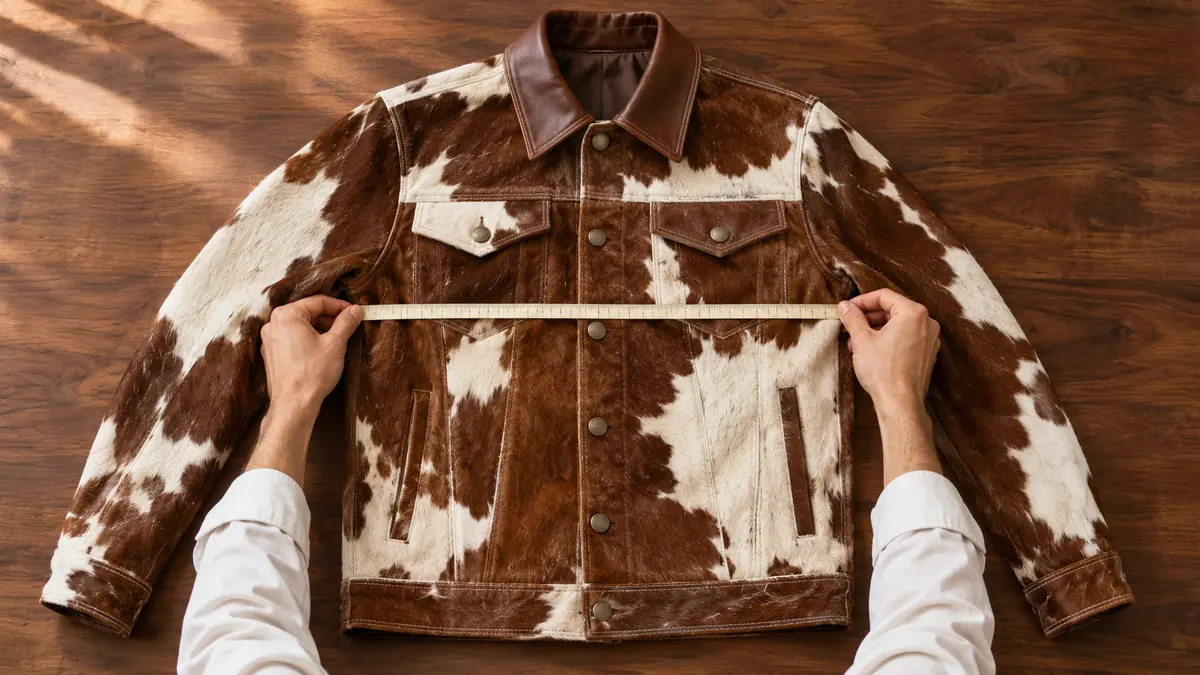
For example, chest circumference is measured around your body. A jacket’s pit-to-pit measurement is taken across the garment when it is laid flat. Those numbers describe different things and should not be compared directly.
| Measurement | What you are measuring |
|---|---|
| Body chest or bust | Around the fullest part of your chest |
| Jacket chest width | Across the closed jacket, usually near the underarms |
| Shoulder width | Between the points specified in the seller’s guide |
| Sleeve length | From the seller’s stated starting point to the cuff |
| Back length | From the stated point near the collar to the hem |
If a chart simply says “chest,” ask whether it means body circumference, garment circumference or flat garment width.
Get Your Measuring Tools Ready
You will need a flexible measuring tape, somewhere to record the results and, ideally, another person to help.
Measure over a light shirt unless the seller gives different instructions. Keep the tape comfortably against your clothing without pulling it tight.
Write down the units beside every measurement. Sending “42” without saying inches or centimeters leaves room for confusion.
Take each measurement twice. If the readings differ, check your tape position before recording the final number.
Measure Your Chest or Bust
Stand naturally with your arms relaxed. Wrap the tape around the fullest part of your chest or bust, passing beneath your arms.
Ask someone to check that the tape stays level across your back. You should be able to breathe normally without the tape squeezing your body.
Record the actual measurement rather than adding extra room yourself. Tell the seller what you plan to wear underneath and ask how their sizing accounts for it.
A maker may already build room into a size based on body measurements. Adding your own allowance without checking can therefore change the intended fit.
Check the Waist and Lower Opening
The chest is important, but the lower part of the jacket also needs to fit comfortably.
Consider where the hem will sit. A short jacket may finish near your waist, while a longer design can extend over your hips.
Measure the relevant area according to the seller’s instructions. Mention if jackets usually feel tight around your waist or hips, even when the shoulders fit well.
This is especially useful when choosing a shaped or fitted design. A comfortable chest measurement does not automatically mean the hem will close comfortably.
Measure Shoulders and Sleeves Carefully
Shoulder and sleeve measurements are easier with help.
For shoulder width, follow the exact points shown in the seller’s guide. If you are measuring an existing jacket, identify whether the guide asks for the distance between shoulder seams.
For sleeves, check the starting point before measuring. Some guides start at the shoulder seam; others use a different route. Wested, for example, measures from the shoulder area toward the desired cuff position.
Use the same method when comparing your measurement with a chart. A correctly measured sleeve can still look too long or too short on paper if the starting points differ.
Compare a Jacket You Already Like
A jacket you own can help explain the fit you want.
Close it normally and lay it on a flat surface. Smooth it gently without stretching the material. Following the seller’s method, record the chest width, shoulders, sleeves and back length.
Then note what you like and what you would change:
“The chest and shoulders feel comfortable, but I would prefer slightly shorter sleeves.”
That gives the seller useful context. It is more helpful than saying you usually wear large.
Choose a comparison jacket with a similar shape. A loose winter coat is not a particularly useful reference for a fitted short jacket.
Allow for the Clothes You Actually Wear
Think about the jacket’s everyday role.
Will you wear it over a T-shirt, a shirt or thick knitwear? Do you want a close fit or more room through the body?
Share that information before ordering. Avoid automatically sizing up, because a larger size can also change the shoulders, sleeves and overall length.
Instead, send your measurements and describe your preferred fit. Ask which available size comes closest to both.
Check Movement Before Keeping the Jacket
When your jacket arrives, try it with the clothing you planned to wear underneath. Follow the seller’s return instructions while checking the fit.
Close the front, sit down and reach forward as you normally would. Notice whether the neckline pulls, the shoulders restrict ordinary movement or the closure feels strained.
Do not depend on a promise that an uncomfortable jacket will eventually stretch enough to fit.
For general product questions, you can also review FATO Leather’s FAQs. For help with a particular jacket, contact FATO Leather with the product link, measurements and preferred fit.
Frequently Asked Questions
Should I order my usual jacket size?
Use it as a starting point, then check the chart for the specific design. Size labels alone do not explain the garment’s proportions.
What should I do if I fall between sizes?
Ask the seller to compare the measurements that matter most for that style. Explain your intended layers instead of automatically choosing the larger size.
Is doubling pit-to-pit the same as measuring my chest?
Doubling a flat chest width gives an approximate garment circumference. It does not turn it into a body measurement or establish how the jacket will fit.
Can I ask about custom sizing?
Yes. Send your measurements and ask which adjustments, if any, are available for the chosen design. Confirm the details before ordering.